
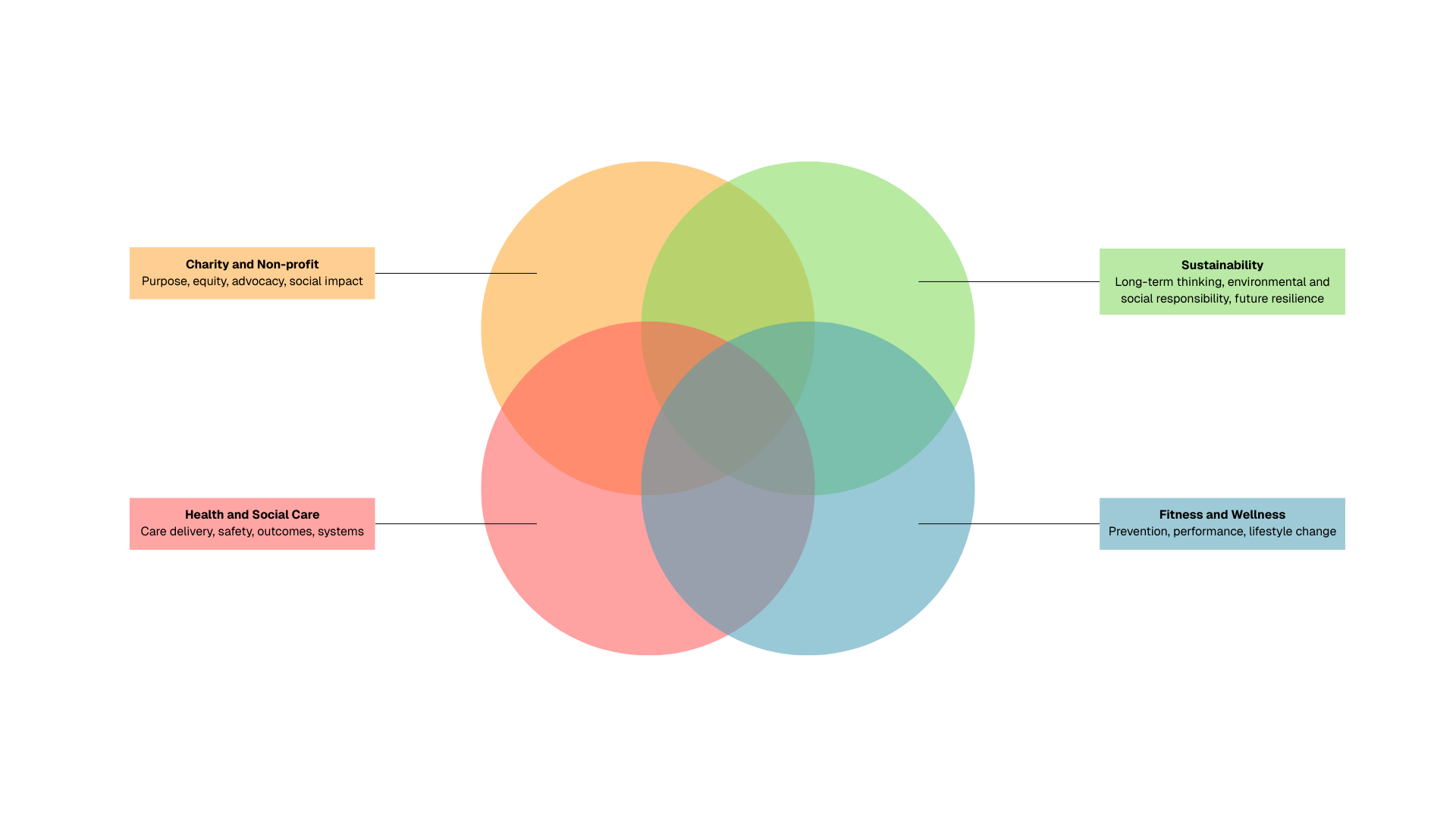
Charities and non-profits operate in a world of funding pressures, accountability, and advocacy. Health and social care organisations are navigating complex systems, regulation, and rising demand. Fitness and wellness brands focus on prevention, performance, and behaviour change. Sustainability-led organisations are thinking long-term, trying to protect what matters next in the face of environmental and social uncertainty.
On paper, these feel like separate worlds but in reality, they overlap constantly. This isn't accidental. It's the reason we choose to work with these four sectors, and it is where the most meaningful work happens.
The power of overlap
When you look closely, the challenges facing these sectors are remarkably similar. All four are working to improve human and societal outcomes in a changing world. All four are dealing with shifting expectations, stretched resources, and increasing complexity. All four are grappling with how to design services, experiences, and communications that genuinely help people, not just tick organisational boxes.
A charity thinking about accessibility and trust has more in common with a health provider redesigning patient journeys than it might expect. A fitness organisation focused on long-term behaviour change faces similar challenges to a sustainability brand trying to shift everyday habits. Lessons learned in one context often transfer directly into another.
This is why intersection matters.
Working across overlapping sectors allows insight to travel. An approach that improves engagement in a community fitness programme may inform how a charity activates volunteers. A service design principle used in health and social care can unlock clarity in a sustainability-led organisation struggling with complexity. Patterns repeat, even when contexts differ.
By deliberately working at these intersections, we avoid reinventing the wheel. We build a deeper understanding of people, systems, and behaviours that applies across multiple environments.
From silos to shared learning
Many organisations are still structured in silos. Sector-specific thinking dominates. Best practice is often trapped within industry boundaries, but this is limiting.
Some of the most effective ideas emerge when you step outside a single sector and start connecting the dots. Prevention over cure is not just a healthcare concept. It applies equally to fitness, to charities supporting long-term outcomes, and to sustainability initiatives focused on future resilience. Community-led change is not exclusive to the charity world. It is just as relevant to wellness brands and environmental movements trying to drive participation and ownership.
This cross-pollination is deliberate. By working across these four sectors, we build a broader perspective on what actually works. We see how different organisations tackle similar problems from different angles, and we bring that learning with us. The result is work that is more informed, more adaptable, and more grounded in real-world experience.
Doing work that matters
There is also a more human reason behind this focus – we want our work to be put to good use. The organisations we partner with are trying to make life better in tangible ways. They are supporting people through care systems, encouraging healthier lifestyles, protecting the environment, or addressing inequality. Their success has a ripple effect beyond commercial outcomes.
That does not mean the work is easy or idealistic. These sectors are often under intense pressure. Funding is uncertain. Demand is growing. Expectations are high. But that is precisely why the work matters. Choosing to work with organisations that are trying to improve the world brings clarity. It sharpens decision-making. It gives weight to the work we do together. When strategy, design, or technology is applied in these contexts, the impact is felt far beyond a single campaign or platform.
Meaningful work is not about being worthy. It is about being useful.
A shared set of challenges
Another reason these sectors belong together is that they are all dealing with systemic change. Health and social care organisations are rethinking delivery models under pressure. Charities are navigating shifts in funding, trust, and digital engagement. Fitness and wellness brands are moving beyond short-term performance towards long-term behaviour change. Sustainability organisations are balancing urgency with long-term systems thinking.
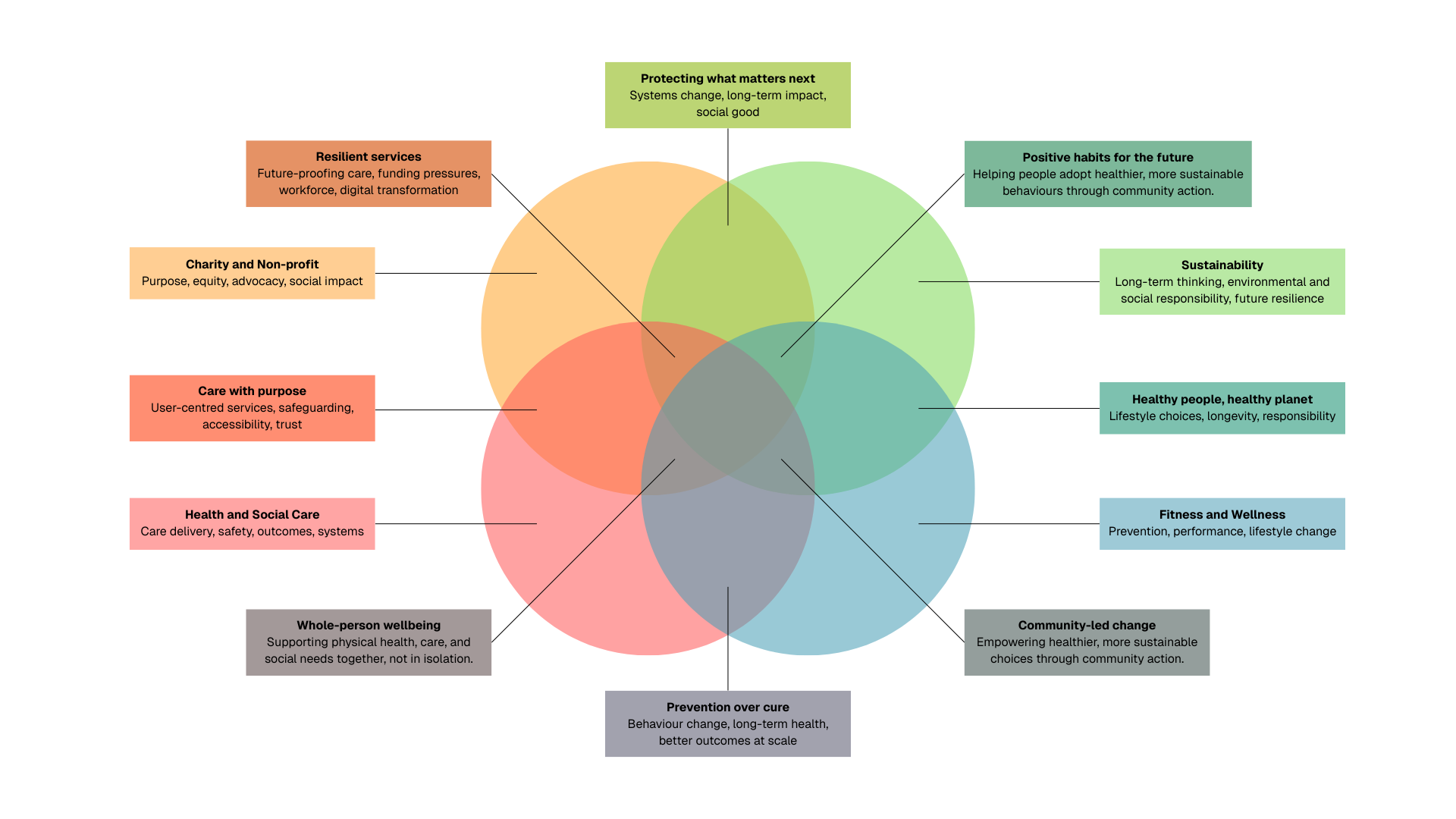
In different ways, they are all trying to build resilience. That shared challenge is reflected in the overlaps. Resilient services. Whole-person wellbeing. Prevention over cure. Healthy people, healthy planet. These are not abstract ideas. They are practical responses to real-world complexity.
By understanding how these themes show up across sectors, we can help organisations move forward with more confidence. We are not imposing a framework. We are reflecting back what already exists, then helping make sense of it.
The diagram as a strategic tool
This is where the model itself comes in. The diagram is not just a neat way to categorise who we work with. It is a strategic tool. It helps us, and our clients, understand where an organisation sits within a broader ecosystem.
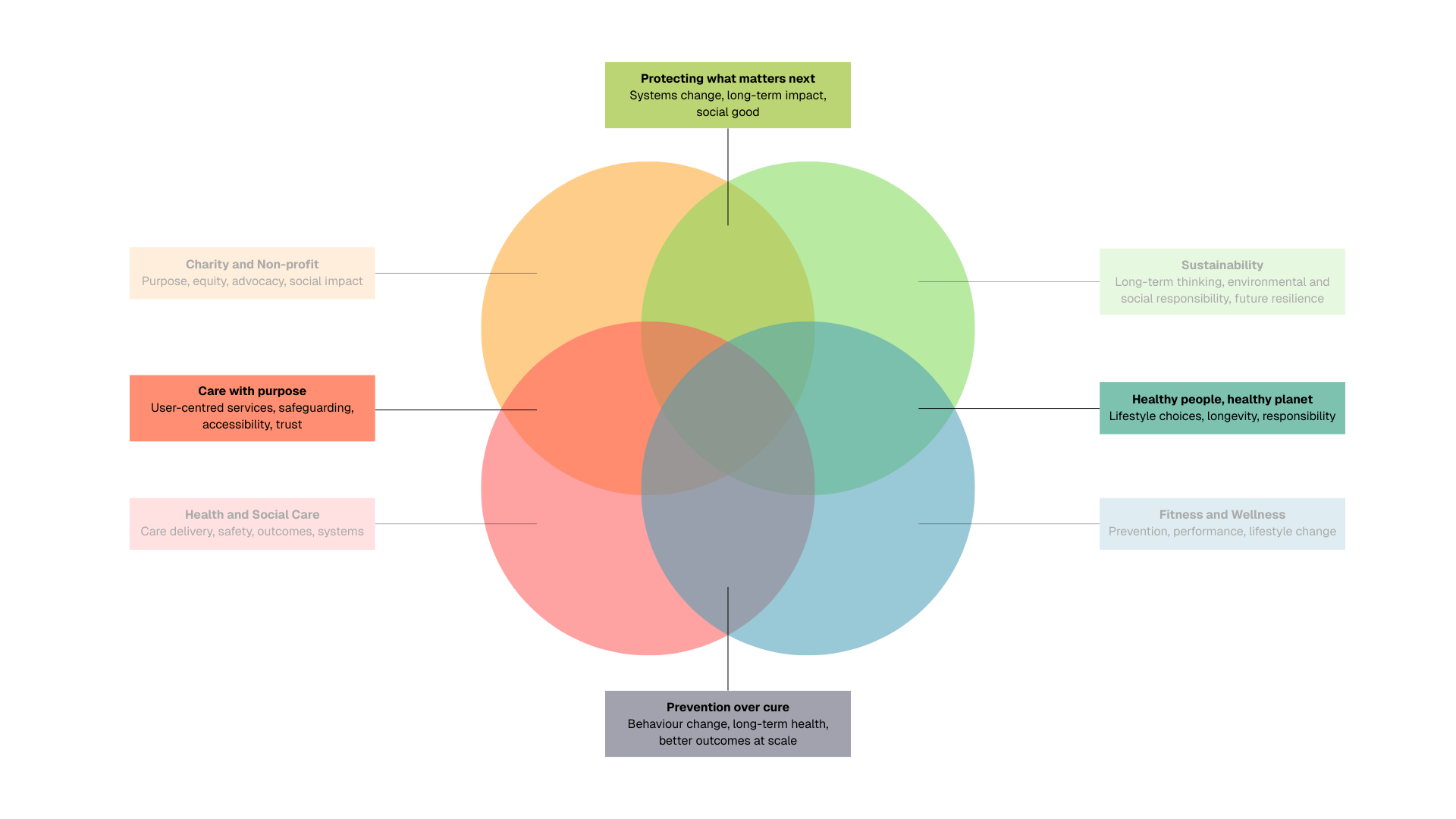
Most brands instinctively define themselves by their sector. A charity is a charity. A healthcare provider is a healthcare provider. A fitness brand is a fitness brand. But people do not experience organisations in sectors. They experience them in moments, behaviours, and needs.
The overlaps reveal where real differentiation lives.
An organisation operating at the intersection of charity, fitness, and sustainability may want to lean into community-led change and positive habits for the future. A health and social care provider working closely with charities may focus on whole-person wellbeing and joined-up care. These positions inform messaging, service design, and campaign thinking in ways that sector labels alone never could.
From positioning to practice
Once you understand where a brand sits within this model, it becomes easier to make strategic decisions.Positioning becomes clearer. Messaging becomes more coherent. Services can be designed around real needs rather than organisational structures. Campaigns can focus on outcomes rather than outputs.
This is especially powerful in service design. When you know whether an organisation is primarily about prevention, resilience, community action, or long-term impact, you can design experiences that reinforce that role.
The same applies to brand and communications. A sustainability organisation that positions itself purely around responsibility may miss the opportunity to connect with wellbeing or lifestyle change. A fitness brand that ignores social impact may struggle to build trust and loyalty. The model helps reveal these blind spots.
A flexible, living framework
Importantly, this is not a fixed map. Organisations move. Strategies evolve. Context changes. The value of this framework is not in putting brands in boxes, but in giving them a shared language to talk about who they are and who they are becoming.
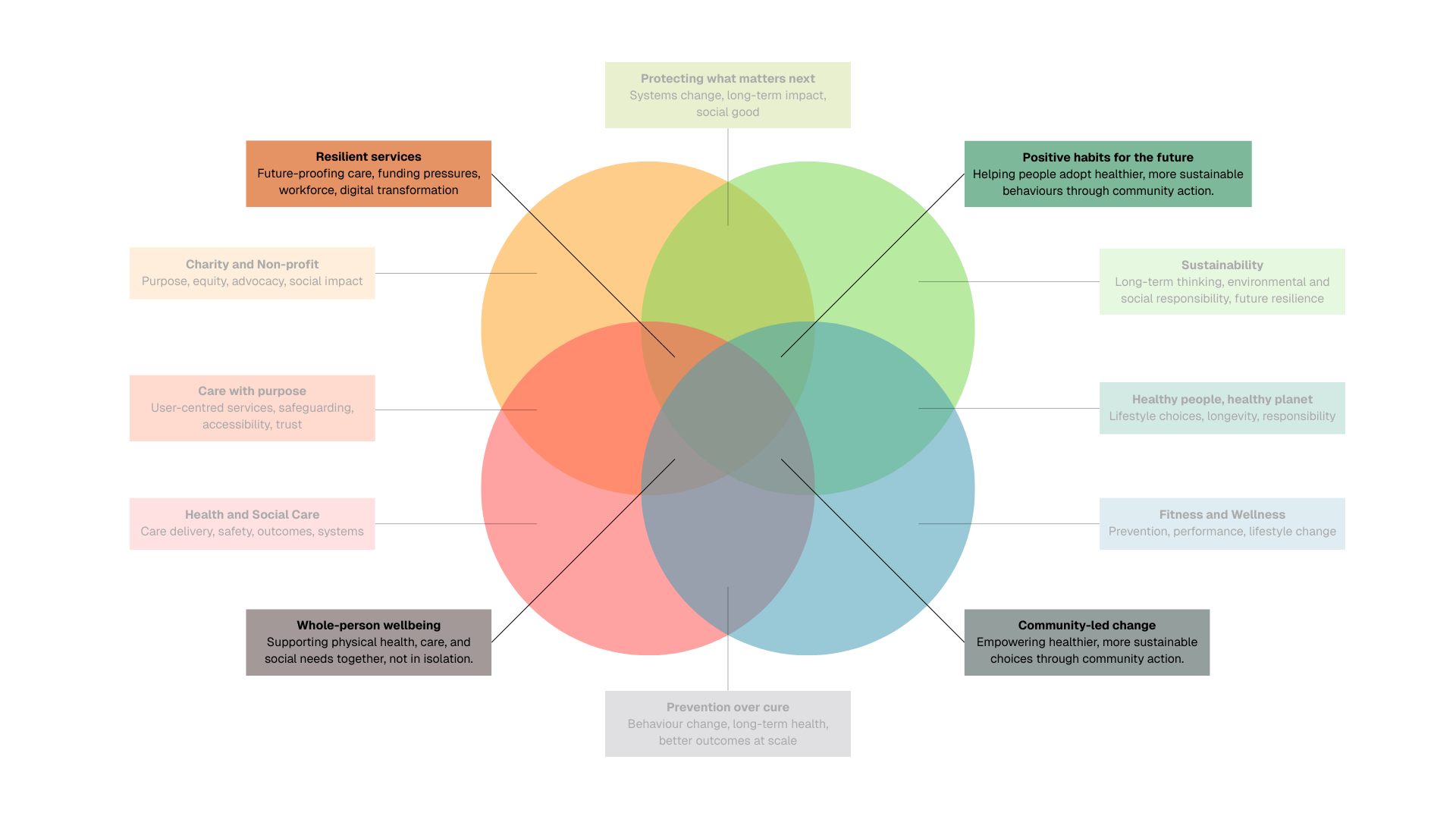
It also gives us a way to have better conversations. Conversations about focus. About trade-offs. About where to lean in and where to let go. That clarity is often what organisations are missing, not more ideas.
Why this matters now
The world these organisations operate in is becoming more complex, not less. People expect more joined-up experiences. Systems are under strain. Behaviour change is harder to achieve. Trust is fragile. In that environment, clarity is a competitive advantage.
By choosing to work with sectors that intersect, and by deliberately learning across those intersections, we are better equipped to help organisations navigate what comes next. Not with generic solutions, but with insight grounded in real-world overlap.
In conclusion
We didn't choose these four sectors because they look good on a slide. We chose them because they share challenges, values, and opportunities. Because insight travels between them and work done well in one can unlock progress in another. And because the organisations within them are trying, in different ways, to make life better for people and for the planet. The diagram is simply a reflection of that belief.
It helps us make sense of where we work, how we learn, and how we help organisations position themselves more clearly. More importantly, it keeps us focused on work that matters, work that connects, and work that moves people and systems forward.